We are pleased to present a seven-part series by Dr. Saulius Norvaišas exploring the concepts of Collective Intelligence and omnicracy. This is not another discussion about artificial intelligence or digital transformation. Rather, it offers a fresh perspective on a fundamental question: How can society better use the intelligence it already possesses?
For more than two decades, Dr. Norvaišas has been developing a pioneering framework based on a simple observation: people collectively hold vast knowledge, experience, and insight, yet much of this intelligence remains fragmented, unheard, or unused. The challenge is not a lack of wisdom, but the absence of effective ways to organize and apply it.
In this series, readers will discover what Collective Intelligence truly means, why ideas should be evaluated independently of their authors, how accountable anonymity can unlock participation, and how more intelligent decision-making can lead to greater prosperity, responsibility, and meaning in human life.
___________________________________________
Part I. Society Has More Intelligence Than It Knows How to Use
Contemporary society is not stupid.
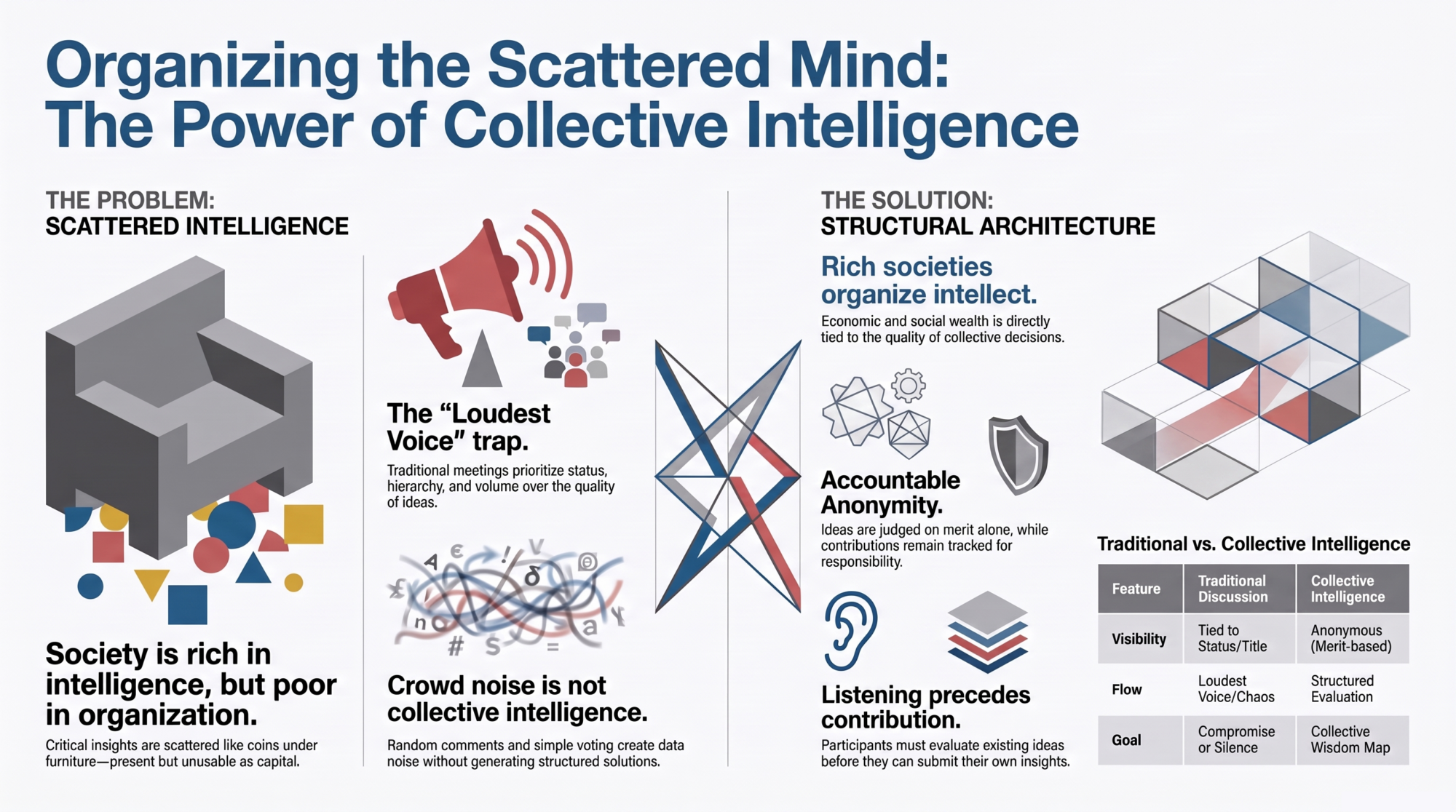
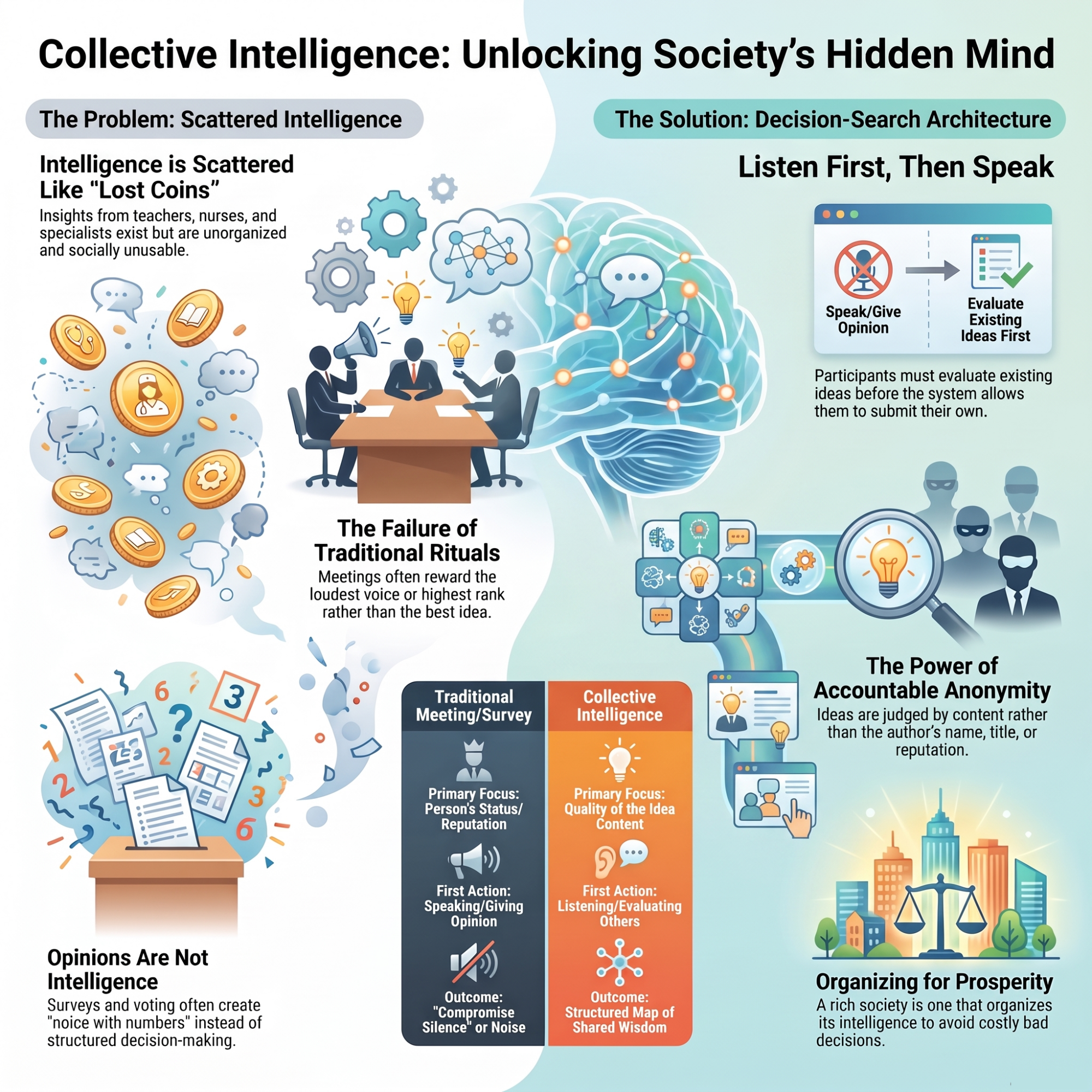
On the contrary, it is full of intelligence. But that intelligence is often scattered like coins around a house: one under the sofa, another in a drawer, a third in a coat pocket, a fourth in the car. The value exists, but it has not been gathered into one place, and therefore, it cannot function as real capital.
The same is true of human insight.
A teacher sees why children are losing the desire to learn. A nurse sees where the healthcare system becomes exhausted faster than the patient. An engineer sees why a project will eventually stop. An entrepreneur sees where money is being quietly wasted inside an organization. A young person senses a future that old institutions do not yet know how to name. A quiet specialist knows the solution, but no one hears him in a meeting because he does not have a high enough chair.
The problem is not that society lacks intelligence.
The problem is that a large part of that intelligence remains socially unorganized.
This is exactly where Collective Intelligence begins.
 Scattered Intelligence
Everyone has seen a situation where everybody understands that something is not working, but nobody knows how to turn that understanding into a decision.
In a company, everyone says that a good idea has “got stuck.” One person says the manager is to blame. Another says there are too many procedures. A third says people are afraid to make mistakes. A fourth says it is unclear who is responsible. A fifth says the decision was made, but nobody is really implementing it.
Everyone holds part of the truth.
But those parts do not connect.
In a meeting, what often wins is not the best idea, but the strongest voice. Sometimes it is a position. Sometimes it is authority. Sometimes it is the person who speaks well. Sometimes it is simply fatigue: after an hour of discussion, everyone wants to go home, so they agree to the option that annoys them least.
What is born then is not a decision, but a compromise silence.
From the outside, it looks as if the organization is thinking. In reality, it is merely moving through a familiar ritual: we talked, we took notes, we agreed to discuss it again, and nothing changed.
Such situations are not only a problem for companies. They repeat themselves in municipalities, schools, hospitals, communities, ministries, projects, universities, and even families. People have experience, but there is no good way to connect that experience so that it becomes a shared field of decision-search.
That is why we can say it very simply:
Society has more intelligence than its usual structures know how to use.
Why It Is Not Enough to Simply Ask People for Their Opinions
At first glance, it may seem that if people have many insights, we should simply ask them. Conduct a survey. Open the comments. Invite them to a discussion. Ask them to vote.
But there is a mistake hidden here.
A multitude of opinions is not yet Collective Intelligence. A flood of comments is not yet shared thinking. Voting is not yet a search for a solution. Sometimes it is only noise with numbers.
Imagine an online comment section under an article about education. One commenter writes about teachers’ salaries. Another writes about children’s phones. A third writes about parental responsibility. A fourth is angry at the government. A fifth makes a joke. A sixth starts arguing with the third. After a few hours, we have hundreds of reactions, but not a decision.
Why?
Because people are speaking next to one another, not within a structured environment, for the search for solutions.
Collective Intelligence does not emerge when many people simply say what they think. It emerges when their thinking is organized in such a way that ideas are submitted, evaluated, compared, tested, and ranked according to how they resonate with collective wisdom.
In short:
Many voices are not yet Collective Intelligence. Collective Intelligence begins when voices become a structured field of decision-search.
 What Collective Intelligence Is
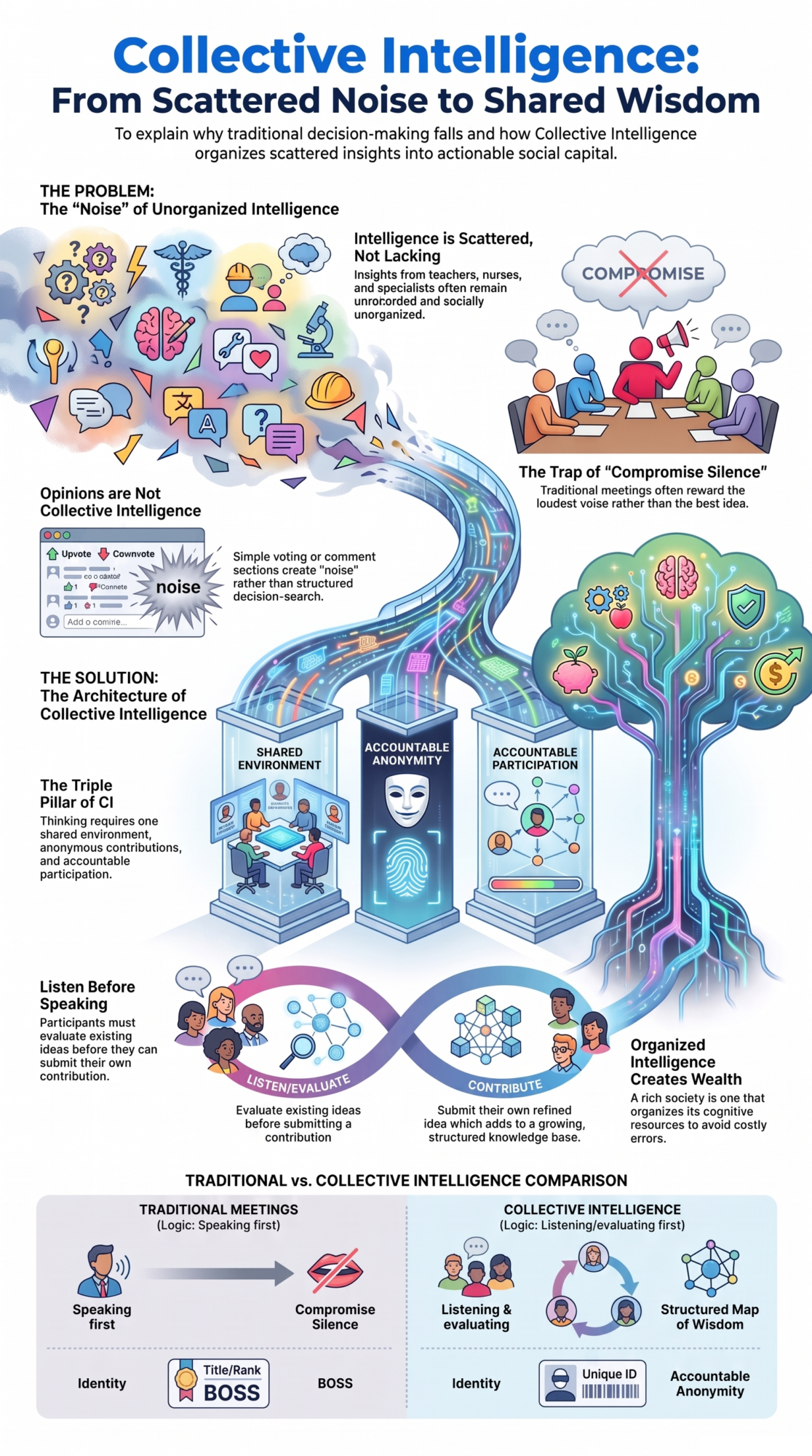
Collective Intelligence is not a crowd, not a survey, and not simple voting. It is a decision- search architecture in which people, within one interactive environment, submit ideas anonymously but accountably, evaluate others’ ideas, and help collective wisdom emerge.
Three words are especially important here: one environment, anonymously, and accountably.
One environment — because only then can ideas meet. If people think separately, write in different documents, speak in different rooms, or comment in different spaces, their thinking does not connect into a shared field.
Anonymously — because an idea must be evaluated not by surname, position, title, or reputation, but by its content.
Accountably — because anonymity does not mean irresponsibility. A participant may be invisible to others, but their contribution remains recorded in the system. Their ideas and evaluations can be counted, assessed, connected to responsibility, and linked to reward.
This is very important.
In ordinary settings, an idea often travels together with the person. If a manager says it, it sounds more serious. If an intern says it, it may sound naïve. If a professor says it, it sounds solid. If an unknown person says it, it may be ignored.
In a Collective Intelligence environment, the surname steps back so that the idea can appear.
But the contribution does not disappear.
That is accountable anonymity.
How This Works in a Simple Example
Let us imagine the question:
Why are good ideas in organizations often not implemented?
In an ordinary meeting, people would start talking. One person would give a long introduction. Another would interrupt. A third would remain silent because he would not want to contradict the manager. A fourth would wait until it became clear which opinion was safe. A fifth would offer a good thought, but it would get lost.
In a Collective Intelligence environment, the process would be different.
A participant does not see all ideas at once as a list. He encounters already submitted ideas one by one, chronologically — in the order in which they were written. Each idea must be evaluated. Only then can the participant submit one clear idea of his own.
This changes the logic of participation.
A person cannot simply throw an opinion into a common pile. First, he must meet the thoughts of others. Evaluate. Compare. Reflect. Distinguish what matters from what merely repeats. Only then can he add his own contribution.
In other words:
In Collective Intelligence, participation begins not with speaking, but with listening.
Later, his idea is evaluated by other participants. The system calculates ratings, unity, polarization, distribution of evaluations, and resonance. What emerges is not merely a list of opinions, but a structured map of shared thinking.
It shows which ideas are strong. Which ones divide. Which ones are unclear. Where a new question is needed. Where the problem lies deeper than it first appeared.
 Why This Matters Now
Collective Intelligence has long been needed. But only now can it become practically possible.
Why?
First, because we now have digital tools. Large groups of people can participate remotely and asynchronously; they do not all have to gather in the same room at the same time.
Second, algorithms can process evaluations: calculate ratings, show unity, detect polarization, and reveal the structure of ideas.
Third, society’s problems have become too complex for one center. It is no longer enough for a few people in an office to decide how education, healthcare, cities, technologies, or organizations should function. Many people see the consequences, but too few participate in the search for solutions.
Fourth, artificial intelligence is changing the entire knowledge environment. It can help write, calculate, summarize, model, and discover connections. But it cannot decide by itself what should be meaningful, fair, non-harming, and beneficial for people. For that, we need human experience, value sensitivity, and the field of collective wisdom.
That is why Collective Intelligence becomes not an addition to technology, but a necessary
social infrastructure.
The internet connected information.
Artificial intelligence accelerated cognitive operations.
Collective Intelligence must organize human decidement.
Why This Is Connected to Wealth and Meaning
One may ask: all right, but what does this have to do with whether society becomes rich and happy?
The answer is simple: society’s wealth depends not only on money, technology, or labor. It depends on the quality of decisions. A bad decision in a city can cost millions. A bad decision in a company can destroy a good product. A bad decision in a school can take away children’s desire to learn. A bad decision in healthcare can create queues, burnout, and distrust. A bad decision in a community can divide people for decades.
The more complex society becomes, the more expensive bad chains of decisions become.
Therefore, a rich society is not simply one that has many resources. A rich society knows how to organize those resources intelligently. And that requires good decisions.
A poor society wastes intelligence. A rich society organizes it.
But Collective Intelligence matters not only for the economy. It also matters for meaning.
It is not enough for a person to be governed, served, persuaded, or entertained. A person wants his experience to matter. He wants his thoughts to be able to contribute to the shared world. He does not want to be only a passenger on a bus whose route is set by others.
A meaningful life begins when a person can contribute meaningfully.
Collective Intelligence creates a space in which a quiet specialist, a teacher, a nurse, an entrepreneur, a student, a local resident, or an expert can participate not as part of the noise, but as a participant in the shared search for solutions.
That is a very large difference.
Society Learning to Use Its Own Mind
Collective Intelligence is not a magic wand. It does not automatically solve all problems. It does not abolish experts, replace institutions, or hand decisions over to the crowd.
It does something more important.
It creates a field in which society’s intelligence can function not in a scattered way, but in an organized way.
One person sees a practical obstacle. Another sees a moral risk. A third sees a technical possibility. A fourth sees an economic incentive. A fifth sees the human cost. A sixth sees the long-term consequence. Separately, these are fragments. Properly organized, they become a shared vision.
This is the promise of Collective Intelligence.
Not everyone has to decide everything. But everyone must have the opportunity to contribute where their experience, competence, or concern is meaningful.
A complex society cannot rely only on one center, one institution, or one group. It must learn to use its own mind.
That is Collective Intelligence: a society that begins to hear itself not as noise, but as possible wisdom.
In the next article, we will discuss an important distinction: why many opinions are not yet Collective Intelligence, and why comments, surveys, or voting cannot replace a structured search for solutions.
Further reading: Collective Intelligence
About the author:
Dr. Saulius Noravaišas is an independent scientist from Lithuania and founder of Omnicracy.net — a platform advancing collective intelligence through the fusion of human and artificial intelligence. Focused on decentralized, merit-based collaboration that enables societies and organizations to adapt and self-optimize without rigid hierarchies or central control.
Learn more at omnicracy.net
Image created by EMN AI Assistant Tom