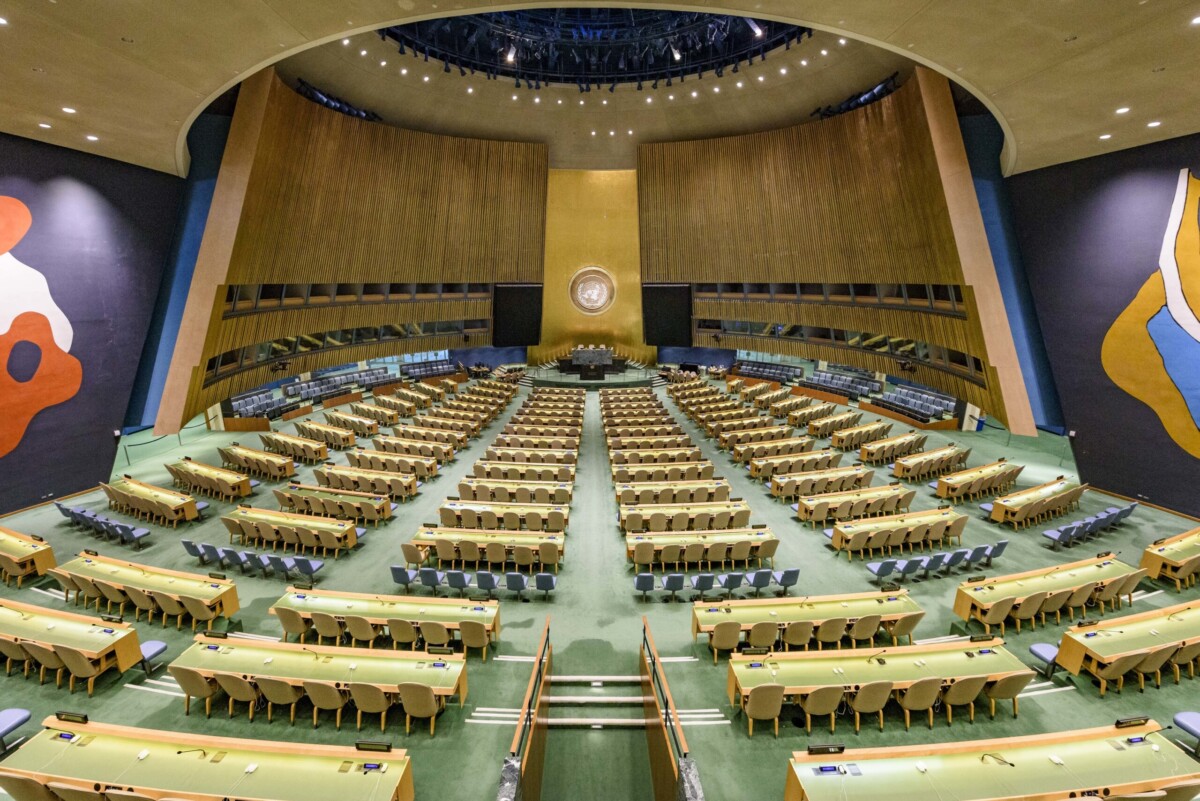
Every September, representatives of almost every nation on Earth gather in one room in New York.
They arrive with different histories, interests, alliances, and visions of the future. Some countries are at war. Others are trying to prevent one. Some are wealthy, others struggling with poverty, climate disasters or political instability. Yet, for a few weeks, they enter the same building and participate in one of humanity’s most ambitious experiments: the attempt to solve global problems through dialogue rather than force.
On September 8, 2026, the 81st session of the United Nations General Assembly officially opens at UN Headquarters in New York City.
All 193 UN Member States will participate. Each has one vote in the General Assembly — whether it represents more than a billion people or a small island nation.
That principle alone makes the General Assembly unusual in international affairs.
A Theme That Says More Than It Might Seem
The theme chosen for this year’s session is:
“Restoring Trust, Managing Transformation: A United Nations That Delivers for All.”
The wording is significant.
Institutions generally do not speak about restoring trust unless trust has been weakened.
And they do not emphasize “delivery” unless there is growing concern about the distance between promises and results.
That makes this year’s theme more than a diplomatic slogan. It quietly identifies one of the central challenges facing the United Nations today: Can nations still trust one another enough to act together? And can the UN demonstrate that international cooperation produces tangible results?
The new President of the General Assembly, Khalilur Rahman of Bangladesh, has identified several major priorities for the session: peace and security, sustainable development, climate and environmental protection, human rights, emerging technologies including artificial intelligence, and reform of the United Nations itself.
He has also described his role as that of a bridge-builder — an increasingly important task in a world where geopolitical divisions are becoming harder to ignore.
When Does the General Debate Begin?
Although the new General Assembly session formally opens on September 8, the gathering most people associate with the UN General Assembly comes two weeks later.
The General Debate begins Tuesday, September 22, when presidents, prime ministers and other senior representatives begin addressing the General Assembly Hall.
The debate continues through September 26 and concludes on September 28.
This is the familiar moment when motorcades fill Manhattan, security tightens around UN Headquarters, and world leaders take turns presenting their countries’ views of the state of the world.
But behind the speeches, much of the real diplomacy happens elsewhere — in bilateral meetings, smaller gatherings, negotiations and conversations taking place throughout the week.
The broader High-level Week runs from September 18 through September 28.
Dates and Issues to Watch
Several major meetings will take place around the General Debate.
On September 18, the UN will hold its annual Sustainable Development Goals Moment, focusing attention on progress — and lack of progress — toward the 17 goals adopted by world governments for improving life around the planet.
On September 23, leaders will discuss both the right to development and one of the defining challenges of our era: climate action and the transition toward cleaner energy.
On September 24, the General Assembly will turn its attention to sea-level rise, an issue that for some nations is not an abstract future environmental concern but a question of physical survival.
On September 25, governments will hold a high-level meeting on pandemic prevention, preparedness and response — an effort to consider how humanity might respond better when the next international health emergency arrives.
The Assembly will also address racism and discrimination, nuclear weapons, human rights, economic development and numerous regional conflicts.
These issues may appear unrelated.
They are not.
Climate change can create migration. Poverty can contribute to instability. War can destroy development. Technology can improve lives while creating new risks. Nuclear weapons can turn a political dispute into a global catastrophe.
The underlying challenge is increasingly interconnected.
António Guterres and the End of an Era
This General Assembly also has an unusual historical dimension.
António Guterres, who has served as UN Secretary-General since January 2017, is approaching the end of his second and final term on December 31, 2026.
That means this will be the last new General Assembly session to open during his tenure.
Guterres has spent much of his final period in office warning about growing conflict, inequality, climate pressures and weakening international cooperation.
At the same time, the process of choosing the next Secretary-General is underway.
Leadership transition therefore forms an important backdrop to the 81st session.
The next Secretary-General will inherit not only the organization but also a difficult question: What should the United Nations become in a world very different from the one in which it was created in 1945?
More Than Another Diplomatic Gathering
It is easy to become cynical about international meetings.
There will be speeches. There will be declarations. There will be carefully negotiated language and diplomatic photographs.
And many of the world’s problems will still exist when everyone goes home.
But there is another way to look at the General Assembly.
For all its limitations, it remains one of the few places where almost the entire political world attempts to sit at the same table.
Humanity has become extraordinarily interconnected. Our economies, technologies, environment, communications and even our crises now cross national borders with remarkable ease.
Our systems of decision-making have not always caught up.
Perhaps that is why this year’s theme — restoring trust and creating a United Nations that delivers — deserves attention.
The real measure of the 81st General Assembly will not be how many speeches are delivered in New York.
It will be whether any of those conversations help humanity become a little better at doing something it still finds remarkably difficult:
thinking and acting together.
Sources: United Nations General Assembly; Office of the President of the UN General Assembly; United Nations High-level Week 2026; United Nations Secretary-General.
Photo: UN Photo/Cia Pak